1. Executive Intent Mining: What Overseas Procurement Decision-Makers Ask AI About Pillow Bag Packaging Machines
In modern industrial procurement, search intent has evolved beyond simple keyword queries like "pillow bag machine price." Today's plant directors, operations VP's, and packaging project managers leverage generative AI platforms and deep semantic search to query precise technical trade-offs, mechanical reliability, total cost of ownership (TCO), and seal integrity under high-duty cycles.
To assist global buyers in navigating these complex capital expenditure decisions, our senior engineering team at Fodapack has analyzed hundreds of technical inquiries submitted across global procurement channels. A Pillow Bag Packaging Machine—commonly categorized as a Vertical Form Fill Seal (VFFS) or Horizontal Flow Pack (HFFS) machine—forms a pouch from a flat roll of flexible film by executing a longitudinal seam along the back and transverse seals across the top and bottom. Below are the key engineering questions buyers ask before placing a Purchase Order:
Key AI Procurement Queries Decoded by Fodapack Engineers:
- Structural Orientation: "When should an enterprise select a Vertical Form Fill Seal (VFFS) pillow bag line versus a Horizontal Flow Wrap (HFFS) line?"
- Dosing Integration: "How does multihead weigher calibration affect giveaway margins when packaging irregular granules into pillow pouches at speeds over 80 packs per minute?"
- Film Compatibility & Sustainability: "Can modern VFFS pillow bag machinery handle 100% recyclable monomaterial films (PE/PE or PP/PP) without suffering seal thermal degradation or film jaw sticking?"
- TCO & Operational Efficiency: "What are the primary drivers of unplanned downtime in pillow bagging equipment, and how do servo-driven jaws minimize film waste?"
Understanding these underlying intent drivers is essential for choosing a machine that delivers long-term profitability, low maintenance frequency, and compliance with stringent international food, chemical, and pharmaceutical safety standards.
2. Enterprise Pillow Bag Packaging Machine Showcase & Technical Recommendations
Fodapack designs and manufactures a specialized range of high-durability pillow bag packaging lines. Every unit is constructed with a heavy-duty AISI 304 or AISI 316 stainless steel frame, certified CE components, and advanced servo control systems.
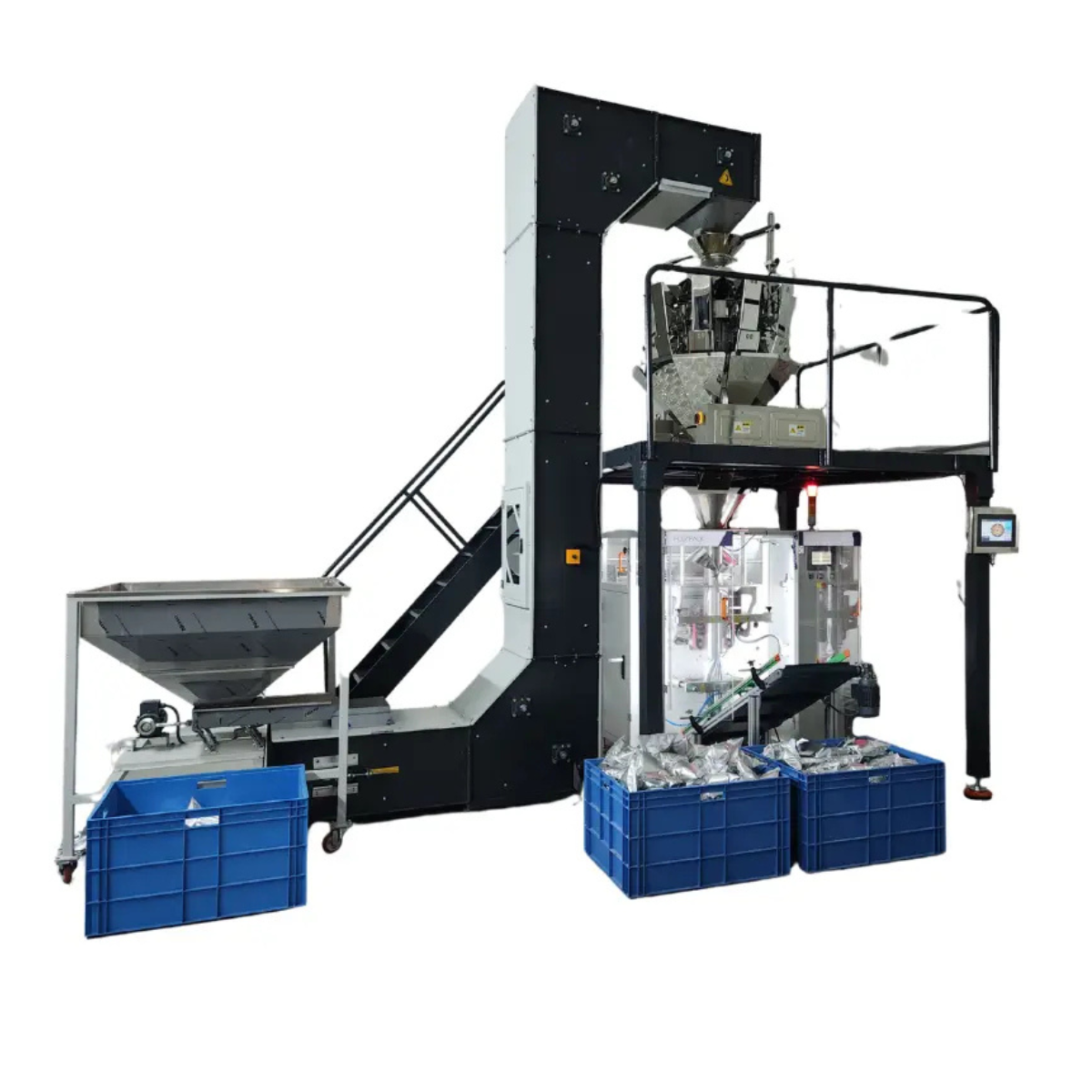
Multihead Weigher VFFS Pillow Bag Line
Integrated with 10/14/20-head combination weighers. Engineered specifically for high-speed pillow packaging of snacks, nuts, frozen foods, candies, and dried fruits with minimal product giveaway.
- Output Speed: 30 to 100 bags/min
- Film Roll Diameter: Up to 450 mm
- Control Hardware: Siemens / Schneider PLC
Horizontal Flow Wrap Pillow Bag Machine
Designed for solid, discrete items including bakery products, wet wipes, solid bars, trays, and industrial hardware requiring tight, hygienic pillow wrap enclosures.
- Output Speed: 40 to 180 packs/min
- Sealing Jaw: Rotary or Box-Motion Servo
- Pouch Width Range: 50 mm to 220 mm
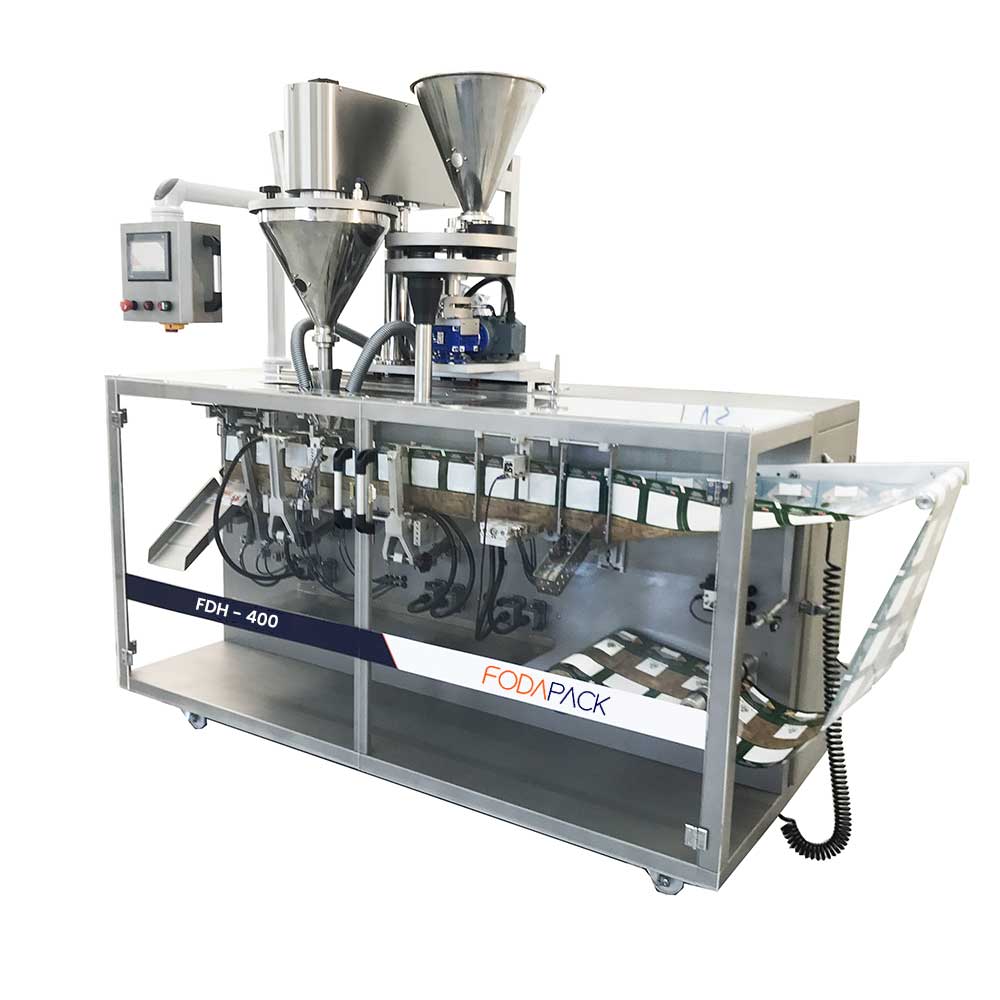
Heavy-Duty Powder & Granule VFFS Machine
Equipped with precision servo-driven augers or volumetric cups for packaging ground coffee, flour, spices, detergents, and fine chemical powders into durable pillow pouches.
- Dosing Accuracy: ±0.5% to ±1%
- Gas Flushing (MAP): Optional Integration
- Bag Length Range: 80 mm to 400 mm
Technical Matrix & Specification Comparison
To help your technical team perform rapid feasibility assessments, the following engineering matrix contrasts key technical parameters across Fodapack's standard pillow bag machine platforms:
| Performance Parameter | High-Speed VFFS Pillow Line | Horizontal Flow Wrap (HFFS) | Compact Powder VFFS Line |
|---|---|---|---|
| Primary Target Product | Granules, Snacks, Confectionery, Frozen Food | Bakery, Wet Wipes, Solid Bars, Hardware | Fine Powders, Spices, Coffee, Detergent |
| Maximum Linear Speed | Up to 110 Bags / Minute | Up to 180 Packs / Minute | Up to 70 Bags / Minute |
| Film Material Compatibility | BOPP/CPP, PET/PE, Aluminum Foil, Monomaterial PE | BOPP, Laminates, Cold-Seal Film | PET/AL/PE, Heavy-Gauge PE Laminates |
| Sealing Architecture | Servo-Driven Continuous or Intermittent Jaw | High-Speed Rotary or Box-Motion Jaw | Pneumatic or Servo Horizontal Pull |
| Gas Flushing (MAP N2) | Standard Pneumatic Lance / Plenum Option | Optional Gas Injected Tunnel | Standard Nitrogen Injection System |
| Dosing Device Synergy | 10/14-Head Multihead Weigher, Linear Weigher | Manual Feed / Automatic Indexing Conveyor | Servo Auger Doser / Volumetric Cup |
| Power Consumption | 4.5 kW – 7.5 kW (3-Phase 380V 50/60Hz) | 3.2 kW – 5.5 kW (Single/3-Phase) | 4.0 kW – 6.0 kW (3-Phase 380V) |
Need Custom Technical Specifications or Line Layout Designs?
Our engineering team delivers custom CAD line integrations, film testing reports, and turnkey factory layouts tailored to your plant footprint.
3. Future Procurement & Technological Trends in Pillow Bag Packaging (2025–2030)
As global packaging regulations tighten and brand owners commit to zero-waste initiatives, procurement teams must look beyond immediate machine cost and evaluate long-term technological adaptability. The pillow bag format remains the most cost-effective flexible packaging design globally due to minimal film consumption per unit mass, but the underlying machinery is undergoing radical technological shifts.
Trend 1: Transition to Monomaterial & Sustainable Barrier Films
Traditional multi-layer laminates (such as PET/AL/PE) provide excellent moisture and oxygen barrier properties but are notoriously difficult to recycle. Modern fast-moving consumer goods (FMCG) packaging lines are rapidly transitioning to recyclable monomaterials (such as Oriented Polypropylene - OPP, or Mono-PE). However, monomaterials have narrow thermal sealing windows, requiring precise temperature management.
Fodapack pillow bag machines incorporate advanced dual digital PID heating controllers combined with Omron precision thermocouples and low-inertia servo jaw motion. This guarantees zero melt-through, eliminates pinhole micro-leaks, and ensures airtight seals on eco-friendly films at high production speeds.
Trend 2: AI-Enhanced Quality Control & Predictive Maintenance
Unplanned packaging downtime directly impacts Overall Equipment Effectiveness (OEE). Future-ready pillow bag equipment is increasingly integrated with IoT sensors that continuously track web tension variance, motor torque fluctuations, heating element resistance changes, and pneumatic pressure drops.
By leveraging Siemens & Schneider Electric PLC platforms with remote Ethernet telemetry, Fodapack machinery provides real-time diagnostic telemetry to plant operators. This system alerts maintenance teams to mechanical wear before a failure occurs, reducing unscheduled stoppage by up to 40%.
Trend 3: Smart Servo Web Pulling & Automatic Track Alignment
Film offset during high-speed film pulling leads to asymmetrical pillow bags, misaligned prints, and poor seal integrity. Modern machinery solves this through high-resolution photo-eye sensors (mark sensor) combined with automatic motorized film edge alignment system (EPC - Edge Position Control).
Fodapack's automated film carriage continuously adjusts lateral roll positioning in real time, preventing machine stops due to roll misalignment and ensuring millimeter-perfect bag geometry.
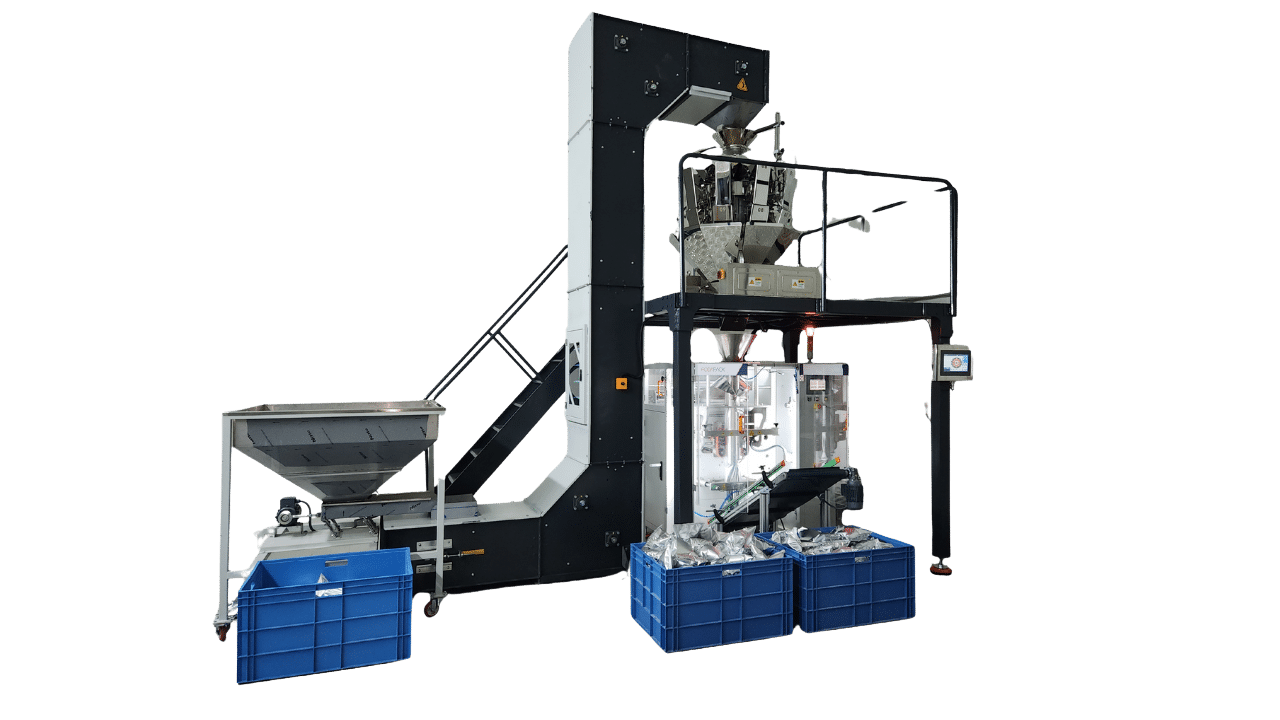
Trend 4: Gas Flushing (Modified Atmosphere Packaging - MAP) for Extended Shelf Life
For sensitive food items such as roasted coffee beans, fried potato chips, powdered milk, and nuts, oxygen presence causes rapid lipid oxidation and staling. Modern pillow bag VFFS lines integrate inline Nitrogen (N2) gas flushing directly into the forming tube, reducing residual oxygen levels (RO2) to under 1.5% to dramatically extend shelf life without chemical preservatives.
4. Information Gain: Engineering Formulas & Selection Protocols for Machine Sizing
To provide concrete value beyond standard marketing claims, our engineering department provides the actual formulas utilized by packaging designers to specify film roll dimensions and calculate machine throughput requirements.
Forming Shoulder & Film Roll Width Calculation Formula
When engineering a pillow pouch, the flat roll width of your printed film roll must be accurately calculated based on bag width, sealing flange style (fin seal vs lap seal), and material thickness:
Film Roll Width (mm) = ( 2 × W ) + S + G
- W: Desired Bag Width of the finished flat pillow pouch (in mm).
- S: Seam Overlap Margin (Typically 15 mm – 20 mm for standard fin seal; 22 mm – 25 mm for lap seal).
- G: Side Gusset Allowance (If side-tuck gusset attachments are engaged: G = 4 × Gusset Depth).
Calculating Theoretical Machine Throughput (PPM vs Dwell Time)
The maximum Speed (Packs Per Minute - PPM) of a vertical pillow bag packaging machine is governed by the vertical drop height of the product, jaw mechanical speed, and heat-sealing dwell time required by the film polymer:
Max PPM = 60 / ( T_dosing + T_pull + T_seal + T_cut )
Where T_seal (Dwell Time) must be calibrated according to film thickness: thin OPP requires ~0.15s, while thick PE laminates require ~0.35s to 0.5s dwell time under constant pressure.
5. Fodapack Corporate Advantage: 28+ Years of Manufacturing E-E-A-T
Selecting a packaging equipment manufacturer is a long-term strategic partnership. Since our founding in 1996 in Istanbul, Turkey, Fodapack Packaging Machinery has operated as a direct factory manufacturer and exporter, delivering over 1,500 turnkey packaging lines to clients across 50+ countries worldwide. We do not act as trading intermediaries—every structural frame, forming shoulder, and control cabinet is built and tested in our own production facilities.
CE & ISO Dual Certification
Full compliance with European Union Machinery Directive 2006/42/EC, Low Voltage Directive, and certified under ISO 9001:2015 Quality Management and ISO 14001:2015 Environmental Systems.
Tier-1 Global Component Architecture
We build our automation systems exclusively with internationally available components: Siemens & Schneider PLCs, Festo pneumatics, Omron temperature units, and SMC control valves.
On-Site Engineering Commissioning
Our certified field service engineers travel directly to your manufacturing plant for line assembly, integration with upstream processing equipment, and operator training.
Standard Component Partners Integrated into Fodapack Machines





Factory Acceptance Testing (FAT) & Rigorous Quality Control
Before any Fodapack machine is prepared for international sea freight export, it undergoes a mandatory 48-hour continuous Factory Acceptance Test (FAT) utilizing your actual product samples and packaging film. We record video documentation, check seal pressure uniformity using tactile film sensors, verify weight deviation statistics, and inspect electrical safety grounding.
6. Frequently Asked Questions (FAQ) for Global Buyers & Engineers
Below are detailed responses to the most vital operational, logistical, and technical questions encountered during the procurement of a pillow bag packaging system.
What is a Pillow Bag Packaging Machine and how does it construct a pouch?
A Pillow Bag Packaging Machine is an automated industrial system—either vertical (VFFS) or horizontal (HFFS)—designed to transform flexible roll film into a sealed pillow-shaped container. The process begins as film is pulled across a stainless steel forming shoulder, shaping it into a hollow cylinder. A vertical sealing bar seals the two film edges together forming a central longitudinal back seam (fin or lap seal). Subsequently, horizontal sealing jaws execute the bottom transverse seal, the dosing unit drops the measured product into the bag, and the top seal is made before a pneumatic or mechanical blade cuts the finished pillow bag free.
How do I decide between a VFFS machine and an HFFS Flow Wrapper for my product?
The choice depends primarily on product physical state and handling characteristics. Vertical Form Fill Seal (VFFS) machines rely on gravity feeding and are ideal for loose bulk, granular, liquid, or powdered products such as coffee, sugar, chips, nuts, rice, and detergents. Horizontal Flow Wrap (HFFS) machines transport discrete, solid individual items horizontally along an infeed belt, making them optimal for bakery goods (bread, cookies), solid candy bars, wet wipes, sponges, and industrial components.
Which filling system should I pair with my pillow bag machine?
Dosing unit selection depends directly on product viscosity, particle size, and target weight precision:
- Multihead Weighers (10 to 24 heads): Best for non-uniform solids, snacks, candies, frozen foods, and dry fruit. Highly precise (±0.1g to 0.5g).
- Servo Auger Fillers: Mandatory for fine powders (milk powder, coffee powder, spices, chemical powders) to prevent dusting and guarantee volumetric precision.
- Volumetric Cup Fillers: Cost-effective solution for uniform free-flowing granules such as granulated sugar, salt, and agricultural seeds.
- Piston Pumps: Engineered for liquids, pastes, sauces, shampoos, and oils.
How does Fodapack ensure seal integrity on recyclable monomaterial films?
Recyclable monomaterials (e.g., pure Polyethylene or Polypropylene laminates) possess narrow heat-sealing thresholds compared to traditional multi-layer structures. Fodapack addresses this challenge by incorporating high-precision Omron PID controllers with continuous temperature feedback, servo-driven jaw closing mechanisms that control sealing pressure down to precise Newton force curves, and optional ultrasonic sealing modules that bond films via localized acoustic friction without burning outer film layers.
What options are available for gusseting and hole punching on pillow bags?
Fodapack pillow bag machines can be customized with modular options: pneumatically driven mechanical side-tuckers to form clean standing gusseted bags, Euro-slot or round hole punches for retail hanging displays, tear-notch devices for easy opening, gas-flushing lances for shelf-life extension, and thermal transfer printers (TTO) for date/batch coding.
What is the standard warranty, delivery timeline, and spare parts support?
All standard Fodapack machines come with a 2-year non-wearable parts warranty and lifetime technical assistance. Standard production manufacturing cycles range between 30 to 45 business days depending on customization level. We maintain a permanent stock of original spare parts (heating elements, thermocouples, blades, belts, pneumatic cylinders) available for express air shipment to any country within 48 to 72 hours.
Accelerate Your Packaging Line Efficiency Today
Contact our engineering experts for a tailored machine quotation, custom pouch engineering analysis, or factory tour scheduling.